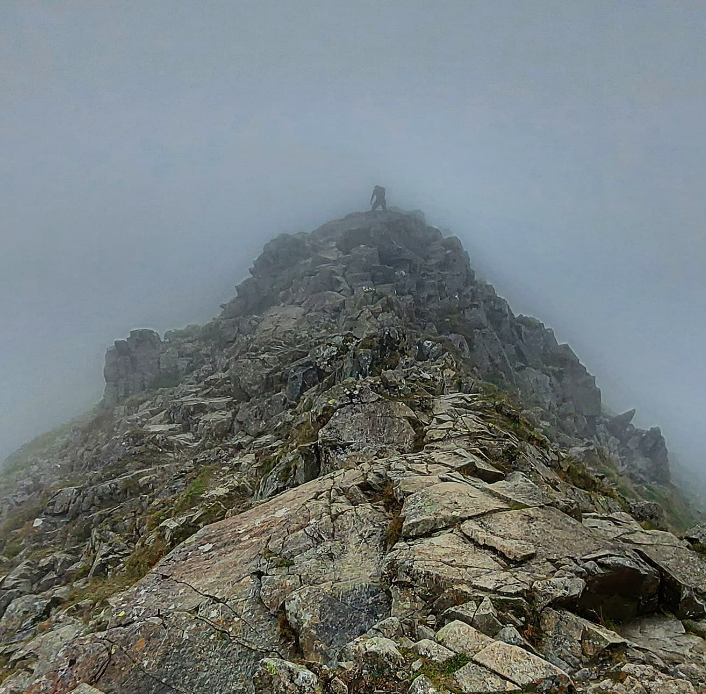
The weather in the mountains can and often does change suddenly and drastically. Don’t be fooled by the blue skies at the start of your walk or the light winds in the local town. This is often not reflective of the conditions you might experience on the mountain.
How to check a mountain weather forecast
If you’re heading outdoors it’s not enough just to check the weather for the local area you’re heading to. Checking the forecast for the specific mountain or mountain range is a fundamental basic that many people skip over. One of my favourite and most reliable weather forecasts for hills and mountains I’ve found and use is the MetOffice Mountain Forecast service. You can view reports for hilly regions as well as specific mountains.
Using the MetOffice Mountain Forecast Service
When you first enter the homepage for the MetOffice mountain forecast, you’ll be met with an interactive map. Choose the area you’re heading to and it will give you a comprehensive overview of the weather expected. I’ll explain how to read the individual information further down.

It will give you a general overview of the weather given for the area you choose including thunderstorms, wind, snow etc as well as changing conditions for different heights up the mountain and an overview of ground conditions too. It’s worth reading all the way through as even if the weather forecast is OK for the day you are planning your adventure, the ground conditions might not be.
It’s now time to search for the forecast on the specific mountain you are heading for. To do this, you can use their interactive map to pinpoint the location of the mountain. You just zoom in and click on the mountain you’re heading for.

Hopefully, you know where the mountain is located on the map but if not, a Google search will bring it up for you.

This will give you a detailed overview of the forecast with a whole host of information to carefully consider;

Along the top is a very brief overview of conditions on the mountain for that day along with sunrise and sunset times. This will help you make sure you’ll have enough time for your hike. If I was reading “snow turning to light sleet”, I’d be thinking that there must be some serious cloud cover which is going to reduce visibility, probably some cold temperatures and this is going to make the day much harder.
Now, let’s break each section down…
Check a Mountain weather forecast; Understanding precipitation

The first section is an overview of the precipitation (rain, drizzle,sleet, snow) likely to fall at each hour during the day. It uses a basic key with darker clouds and more rain drops for heavier rain to a sun for bright, cloud free summits (although cloud free isn’t guaranteed). The MetOffice use LOADS of different symbols to provide you with the best forecast they can. Look at all these symbols!


Precipitation falls much heavier in the mountains and it can come and go very quickly without much warning. Heavy precipitation can create unexpected hazards like rising streams and rivers forcing you to change your route. Plus, even the best waterproof gear won’t keep you completely dry in terrible conditions.
What to do if you’re caught in a thunderstorm in the mountains?
The weather can change so quickly in the mountains so it’s really important to pay attention to the weather and turn around if you can see the conditions deteriorating. If you are ever caught in a thunderstorm though, it’s really important to follow these tips;
- Avoid stopping on an exposed ridge or under an isolated tree where you’ll be the highest object
- Move away from water, lakes and streams as water is a conductor of electricity
- Lay down all your metal objects and move away from them
- The best position is crouched down (feet together, arms around knees and head on knees) on top of your backpack so that your feet aren’t touching the ground
- If you’re in a group, leave space between you and other members
- Wait until the next clear interval to continue (or get off the mountain)
Check a Mountain weather forecast; temperature and feels like temperature

Temperature usually decreases by around 2 degrees celsius for every 300m gained but this can vary. On sunny and warm days, you might not notice it too much. However, on colder, wet days the temperature change, along with wind direction, can make it feel much colder. Looking at both the temperature and “feels like” temperature will give you a good indication of what to expect. Make sure you have enough layers on, waterproofs and extra in your bag.
Always be on the lookout for signs of hypothermia too;
- Shivering
- Feeling very tired
- A sudden lack of interest or concern
- A reduction is rational decision making
- Slipping and stumbling
Check a Mountain weather forecast; wind direction, speed and gust speed

The wind speed on a forecast is always the average that you might experience which means sometimes it will be higher and at other times it might be lower. The arrow shows the direction that the wind is blowing and the letters are the direction the wind is blowing from.
E.g NNW would indicate a wind blowing from the north northwest.
As a basic, northerly winds are often colder whereas southerly winds are warmer.
Wind from the west are often wet and from the east they are often cold too.
As you gain height up a mountain, the winds will strengthen and will increase even further over ridges and the tops of hills.
Wind speed and their effect on you
As a general guidance, gusts of over 30mph can affect your balance so it’s definitely best to avoid exposed areas in those conditions.
In winds of over 50mph, it becomes difficult to walk and you may find yourself being forced off the path you’re taking and regularly losing your balance.
In over 60-70mph, forward motion is almost impossible. These strengths of winds are incredibly dangerous and there is a high risk of being blown over and injuring yourself. You’ll probably have to find shelter, which on a mountain might be impossible.
Constant winds at any of these speeds also add to the difficulty of gusts. With the forecast for Scafell Pike at a consistent minimum of around 40mph, this is a day I’d be avoiding heading into the mountains especially with the heavy rain forecast and cold temperatures.
Take a look at this video (and put your sound on) from a trip to Scotland; the wind gusts were 45mph but a constant 30mph. They felt so much worse when we reached an open section towards the top and it was a struggle to stand straight. We headed back down and didn’t attempt the summit.
Check a Mountain weather forecast; Visibility

The visibility on a mountain forecast measures a distance at what an object can be seen in front of you.

I would always err on the side of caution with these readings and take into account other factors such as cloud cover (from the general overview), if fog is present as that can seriously hinder your visibility too.
Take a look at this photo; if you couldn’t navigate using a map and compass, would you know which direction to take from the summit? These are the kinds of conditions you might face so something to consider before heading off into the mountains.

Check a Mountain weather forecast; Humidity

Humidity is the amount of water vapor in the air. If there is a lot of water vapour, the humidity will be high. The higher the percentage of humidity, the wetter it will feel outside which can leave you feeling damp and and reduces your body’s ability to evaporate sweat. This means you might end up feeling even colder.
Check a Mountain weather forecast; UV Levels

UV levels indicate the strength of the sun so are more appropriate on sunny days (although even in winter you can get sunburn) and it follows different categories. It goes up to 11 which is extreme and is the point you should avoid being outside at midday without protection.

Something to think about;
On the same day as this forecast, the weather in Keswick, which is the nearest major town to one of the start points to walk up Scafell Pike, the weather forecast predicted clear skies, light wind, good visibility, some light drizzle but also periods of sunshine and 20mp gusts. This is why it is so important to check the specific mountain forecast rather than a local town. Just because the forecast is nice lower down, the weather can be drastically different, and dangerous, in the mountains.
Other weather forecasts
It’s a good habit to get into to check not just one mountain forecast but two or three to give you the best understanding of what the conditions might be like.
Two of my other go to forecasts are Mountain Weather Information Service (MWIS) and Mountain Forecast.
Top tips for reading the mountain weather forecast:
- Check the general weather for rain/snow/sun but look at the other aspects of the weather too
- The feels like temperature is an important one for packing appropriate clothes because it takes into account other factors so is more accurate. Temperatures in the mountains drop by around 1 degree for every 100m you gain.
- Wind speed and direction.
The general rule for wind speed is anything above 30mph gusts can affect your balance and above 50 mph will seriously affect how easy it is to walk
- Visibility – if thick cloud or fog comes in over the hills or mountains it can make navigating extremely challenging
- Don’t just check one weather forecast – check multiple so you have a better idea of what the experts are expecting.
I hope this was helpful – let me know in the comments!
One response to “How to check a mountain weather forecast”
This is really interesting and helpful thank you for posting this.