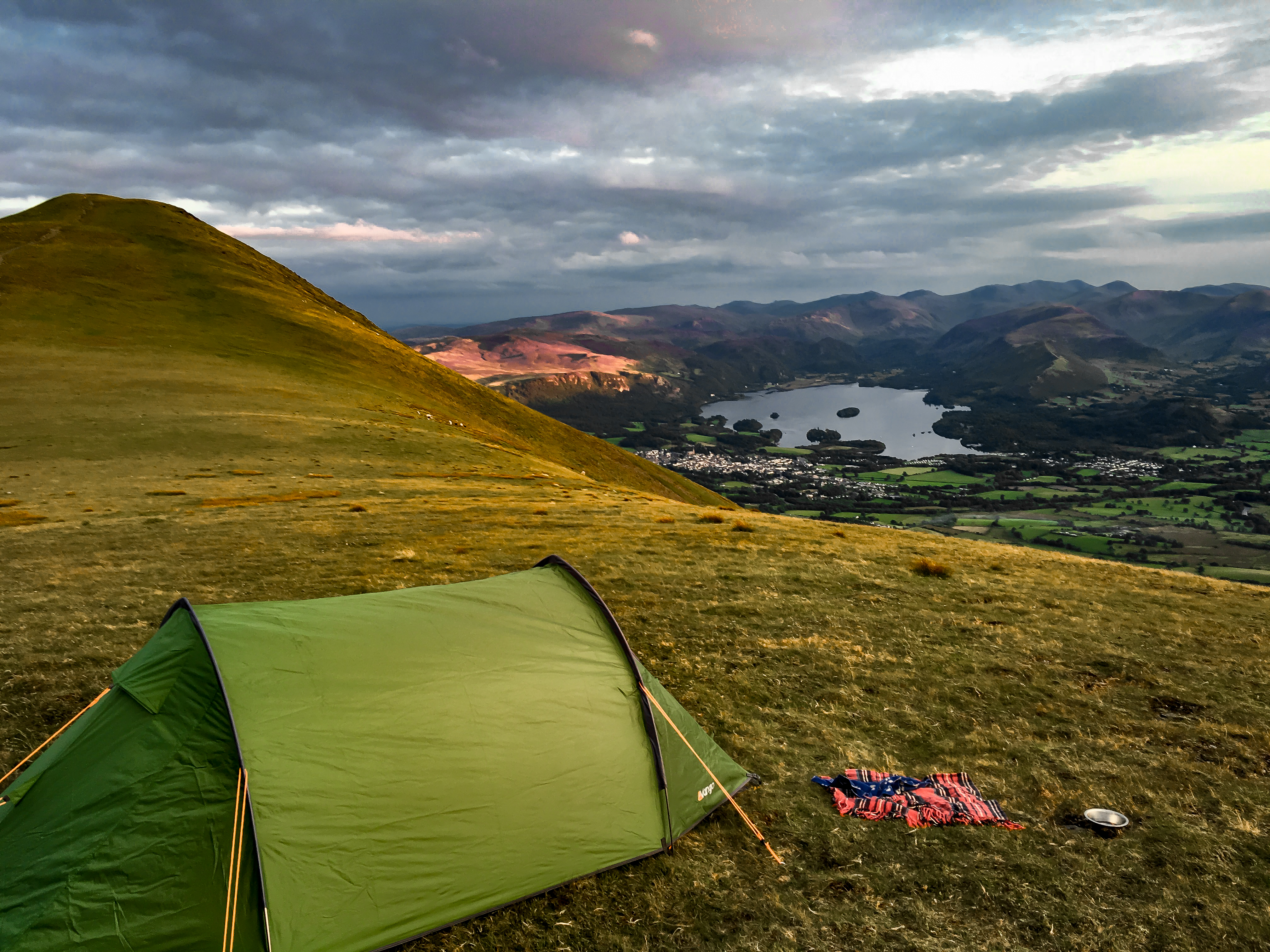
Imagine; you’re snuggled up in your cosy sleeping bag, the first light of day flooding through your tent. Birds sing outside, signalling the start of a new day and as you unzip the tent door, the mountains stretch far in front of you. You have an unobstructed view down to the glistening lake below. The golden glow of the sun rises tentatively from behind the peaks, turning the sky all shades of candy floss. You clutch your morning brew, breathe in that fresh mountain air and feel free. Then it hits you; it’s actually illegal to wild camp in the UK. Oops.
What is wild camping?
It’s basically sleeping outside out in the wild of nature, rather than on a campsite where facilities are provided. With wild camping, you’re truly at one with nature. No showers, no toilets, possibly no phone signal, no electricity, no heating, no other people and no nearby pub. Just you and the outdoors. How you choose to camp will be up to you; in a tent, a bivvy (like a waterproof jacket for your sleeping bag), hammock camping or maybe even just under a tarp. Wild camping should be a low key affair; it’s not the time to be taking a big group of mates up a mountain to have a party. Think of solitude, peace and immersion into nature and you’ll be on the right track.
Is wild camping illegal in the UK?
In a nutshell, yes, sort of. It’s unfortunately illegal to wild camp in most of the UK. However, it is generally accepted as long as you follow some basic guidelines. Across most of England, Northern Ireland and Wales, there are generally no legal rights to wild camp and in some places you might find yourself needing a permit. Rules around wild camping in the UK are strict and confusing at times but they are there to protect the natural environment from unnecessary damage.
Is wild camping legal in England?
In England, most of the land is privately owned by somebody. This might be an individual landowner, company, organisation, charity or even the government. Although wild camping isn’t banned, the only way to wild camp legally is to get permission from the landowner. If you choose to wild camp on land without the landowners permission then you will be committing trespass. Trespass is a civil offence (this means it’s not an arrestable offence) as long as you leave the land as soon as you are asked to by the landowner or someone acting on their behalf.
This applies regardless of where you are. You could be on a remote part of a mountain but the chances are you will still be on someone’s land and will still need their permission to camp.
The only place that it’s not currently illegal to wild camp in the UK is in Dartmoor National Park. However, the current landowners are currently taking the case through the Supreme Court to have wild camping banned on their land.
Is wild camping legal in Wales?
The rules for Wales are pretty similar to that of England and permission must be gained from the landowner.
Is wild camping legal in Northern Ireland?
I bet you saw this coming; it’s the same story for Northern Ireland as in England and Wales. To wild camp legally, you need to get permission from the landowner. Northern Ireland Forestry Service does issue wild camping permits at some of its sites. You can book these through their website.
How do I find the landowner to get permission to wild camp in the UK?
Finding the landowner can be tricky but the best place to start is a quick Google Search. For example, say you wanted to wild camp on Scafell Pike, a quick search shows that the mountain is owned by The National Trust and they are easily contactable.

Asking local farmers is another good way of finding the landowner but don’t just turn up unannounced at their farm. Write a letter in advance and let them know who you are, where you’re planning on wild camping and wait for their permission.
You can also try the Land Registry service to see who the landowner is. This is available online however some of the information will require a fee to be paid.
Of course, this takes time and there is no guarantee that the landowner will get back to you or even that you’ll be able to find the landowner at all. Unfortunately, there are no complete, publicly accessible documents that will give you all the information you need.
How can I wild camp legally in the UK?
Gaining permission from the landowner is the main priority and many landowners will be happy for you to wild camp. Just be sure to get their permission first.
However, within the wild camping community, there are guidelines which, if you follow them, you should be able to wild camp without any issue. That is so long as you remain respectful of their land and the other land users. These include;
- Camping up high on hills and mountains and away from homes, buildings, tracks and farm walls and fences
- Reduce the number of people and tents (this isn’t a chance for a party up a hill)
- Pitch your tent late at night and leave early in the morning so you don’t disturb other land users
- Don’t trample on plants or move rocks
- Don’t light open fires
- If you need to the toilet, human waste needs to be packed away or dug into a deep hole. It should be at least 30m away from any water source or path. Don’t leave toilet roll on the ground either.
- Don’t wash dishes or use soaps in rivers, lakes or any other body of water
- Keep the site peaceful and minimise any noise
- Carry all your litter away with you
- There should be no trace that you’ve even camped (we’ll get into the nitty gritty of this in a later blog)
- If a landowner, or someone on their behalf, asks you to move on, you should do so immediately
Is wild Camping in Scotland legal?
There’s a misconception that the right-to-roam laws in Scotland mean that you’re free to camp anywhere you’d like but this isn’t the case. With that said, Scotland does generally permit wild camping (can we get a “hooraaay”) on beaches, rivers, hills and mountains.
Rules for wild camping in Scotland
- Wild camping should be done in small numbers. It should be for no more than two or three nights in the same place
- Don’t cause problems for local people or land owners – avoid farms, crops and private land
- Stay away from buildings, roads and historic structures
- Avoid the disturbance of deer stalking and grouse shooting
- In some areas of Loch Lomond and The Trossachs National Park you must obtain a permit to wild camp. This applies between March and September
For more information see the Scottish Access Code for wild camping. I also recommend checking out this reel by Juls, who makes understanding this nice and simple over on her Instagram page over_stepping.
So, even though it is illegal to wild camp in most of the UK, it is still posible to do it. Wild camping, while it may seem like a great idea, actually needs a lot of care and attention if you are to do this legally. This doesn’t mean you should be put off; just do your research and consider your options carefully.
Now that you understand the laws around wild camping in the UK, you might have questions about the equipment you need. Check out my post here about choosing beginner wild camping equipment. Please remember to leave a commen below! I’d love to hear from anyone other wild campers or if you too are just starting out.

A Beginner’s Guide to Wild Camping Equipment
A beginners guide to choosing wild camping equipment including tents, sleeping bags, sleeping mats, stoves and more as well as links to good quality camping equipment.

If you want to follow my journey into wild camping you can see more on my Instagram page or take some time to read more blogs here.
Happy camping and don’t forget to subscribe!
2 responses to “Is it illegal to wild camp in the UK?”
[…] reading this then you’re probably ready to embark on your first wild camping experience. You’ve checked the legal guidance on wild camping in the UK, researched and sorted all the equipment you’ll need and now it’s time to head out into the […]
[…] you’ve read up on the legalities to wild camping in the UK, then you’ll know that in most parts of the UK, it’s illegal without prior consent from the […]